The Raw Card Pricing Playbook - Part 1 - Price vs. Market Value
Cass Sapir

Price vs. Market Value: Should You List Below Market, At Market, or Above Market?
Every dealer has asked the same question:
What should I list this card for?
You scan a card. CDP identifies it. A market price appears.
Now what?
Do you list it at market? Round up? Round down? Price it at $1.99? $2.99? $3.99? Do you try to move it fast, or do you squeeze a little more value out of it?
That question seems simple.
But for raw, low-end cards, the answer is not always obvious.
That is why we are building the Raw Card Pricing Playbook — a series designed to help dealers use market price more intelligently.
This first article focuses on the most important question:
Should a dealer price below market, at market, or above market?
The Card We Will Follow
Throughout this series, we are going to use one card as our example:
2022 Topps Update Bobby Witt Jr. Rookie Debut #US187 — raw, ungraded
It is a perfect teaching card.
It is not worthless. It is not high-end. It is not ultra-rare. It is a recognizable rookie-year card of a well-known modern player, but it still lives in the low-dollar raw-card world where pricing decisions are not obvious.
Imagine CDP shows a raw market price of $1.87.
What should the dealer actually do?
List it at $1.50?
List it at $1.87?
List it at $1.99?
List it at $2.99?
Hold it?
Bundle it?
Price it higher because Bobby Witt Jr. is a desirable player?
Price it lower because the card is common?
That one card opens the whole pricing problem.
Market Price Is the Anchor, Not the Answer
The biggest mistake dealers can make is treating market price as a command.
If the market price is $1.87, that does not automatically mean the best listing price is $1.87.
Market price matters. It gives you the anchor.
But the final sale price should depend on what you are trying to accomplish.
Are you trying to move inventory quickly?
Are you trying to maximize revenue?
Are you pricing a strong card with buyer demand?
Are you clearing common cards?
Are you willing to wait?
Those questions change the answer.
The better question is:
Given this card’s market price, demand, supply, player, set, and selling goal, what is the smartest sale price?
What We Studied
We analyzed millions of raw, ungraded cards listed through Card Dealer Pro.
To keep the analysis clean, we focused on cards that were:
Raw / ungraded
Actually listed
Listed in the past 365 days
Excluded from the most recent 30 days, so every card had time to sell
Priced with a real sale price
Matched to a real raw market price
Based on raw market prices with at least 5 sales
Not extreme outliers above 500% of market price
The final dataset included:
7,214,780 listed raw cards
1,086,065 sold cards
15.05% overall sell-through
Then we grouped cards by how their sale price compared to raw market price.
The Core Finding
The pattern was clear:
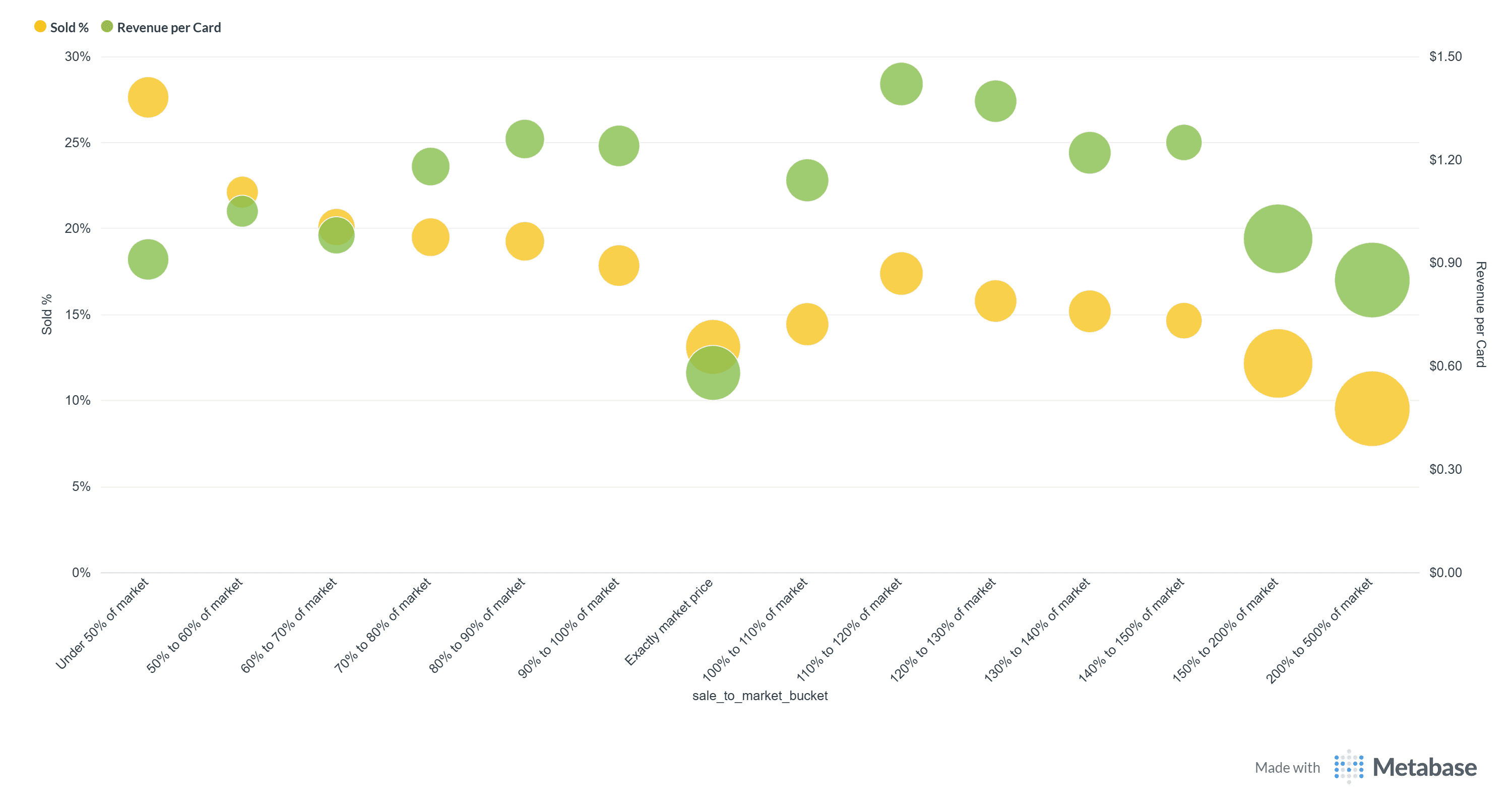
The deeper the discount, the faster cards sold — but the best revenue result did not come from racing to the bottom.
Across the full dataset:
Cards priced under 50% of market had the highest sell-through: 27.61%
But those cards generated only $0.91 in quantity-adjusted revenue per listed card
The strongest revenue result came from cards priced at 110% to 120% of market
That bucket sold at 17.38%
It generated $1.42 in quantity-adjusted revenue per listed card
That is the key pricing tension:
Sell-through and revenue are not the same thing.
Discounting helps move inventory.
But deeper discounting can leave money on the table.
The Overall Data
Here is the full view across all raw cards in the analysis:
Sale Price vs. Market | Sold % | Avg Sale Price | Revenue / Listed Card |
|---|---|---|---|
Under 50% of market | 27.61% | $2.72 | $0.91 |
50% to 60% of market | 22.11% | $3.15 | $1.05 |
60% to 70% of market | 20.07% | $3.36 | $0.98 |
70% to 80% of market | 19.48% | $3.69 | $1.18 |
80% to 90% of market | 19.25% | $4.07 | $1.26 |
90% to 100% of market | 17.84% | $4.18 | $1.24 |
Exactly market price | 13.11% | $4.43 | $0.58 |
100% to 110% of market | 14.43% | $4.89 | $0.96 |
110% to 120% of market | 17.38% | $5.13 | $1.42 |
120% to 130% of market | 15.78% | $5.71 | $1.37 |
130% to 140% of market | 15.17% | $5.49 | $1.14 |
140% to 150% of market | 14.64% | $5.42 | $1.25 |
150% to 200% of market | 12.15% | $8.02 | $0.97 |
200% to 500% of market | 9.52% | $8.97 | $0.85 |
The lesson is not “always price below market.”
It is also not “always price above market.”
The lesson is:
Use market price as the anchor, then decide whether you are optimizing for speed, revenue, or patience.
What Happens When You Price Below Market?
Pricing below market works when your goal is movement.
The data showed that cards priced under market generally sold at higher rates than cards priced far above market.
For example:
Under 50% of market: 27.61% sold
50% to 60% of market: 22.11% sold
80% to 90% of market: 19.25% sold
90% to 100% of market: 17.84% sold
If a dealer wants to move stale inventory, clear space, build sales velocity, or generate quick cash, pricing below market can make sense.
For our Bobby Witt Jr. example, if CDP shows a raw market price of $1.87, a below-market strategy might look like:
$1.50 for speed
$1.49 if using clean low-end pricing
Possibly part of a lot if the dealer wants to move volume
That may help the card sell faster.
But it may not maximize the return.
What Happens When You Price Near Market?
Pricing near market is the balanced approach.
It is usually the safest starting point when the dealer does not have a strong reason to discount heavily or charge a premium.
For the Bobby Witt Jr. card with a $1.87 market price, near-market pricing might look like:
$1.87 if pricing literally
$1.99 if using a clean buyer-friendly ending
$2.00 if using clean whole-dollar pricing
But here is the important point:
Exact market price is not always the best listing price.
A $1.87 listing may look precise, but it can also look awkward. In a later article, we will explore why clean price endings like $1.99, $2.00, and $2.99 often make more sense than random penny prices.
For now, the key lesson is simple:
Near market does not have to mean exact penny matching.
What Happens When You Price Above Market?
Pricing above market can work when there is a reason.
The strongest revenue-per-listed-card bucket in the overall analysis was 110% to 120% of market.
That does not mean every dealer should price every card 10% to 20% above market.
It means that cards capable of supporting a modest premium often performed well.
A card may deserve an above-market price if:
The player is desirable
The card has strong eye appeal
The card is cleaner than typical raw copies
Demand is rising
Supply is thin
The market comp looks stale
The seller is willing to wait
The card has a better presentation than competing listings
For the Bobby Witt Jr. card, an above-market strategy might look like:
$2.49
$2.99
Possibly higher if demand is strong or the card is especially clean
That kind of price may not sell as fast as a discount price.
But it may generate more revenue per listed card.
What Happens When You Price Too Far Above Market?
This is where the data becomes very clear.
Performance dropped when cards were priced far above market.
Across the full dataset:
150% to 200% of market sold at 12.15%
200% to 500% of market sold at only 9.52%
The 200% to 500% bucket generated only $0.85 in revenue per listed card
That means aggressive overpricing can hurt both sell-through and revenue.
For the Bobby Witt Jr. card, if the market price is $1.87, a price like $4.99 or $5.99 might only make sense if there is a specific reason:
The card is unusually clean
The player is hot
Supply is thin
The market price is stale
Without a reason, pricing too far above market can turn a good listing into dead inventory.
The Dealer Decision Framework
When CDP shows a market price, dealers should not ask only:
What is the market price?
They should ask:
What is my strategy for this card?
There are three basic strategies.
1. Fast Sale Strategy
Use this when the goal is speed.
Typical approach:
Price below market.
Examples:
Around 70% to 90% of market
Lower for stale or common inventory
Useful for clearance, cash flow, or moving volume
For the Bobby Witt Jr. card at $1.87, a speed price might be:
$1.49 or $1.50
2. Balanced Strategy
Use this when the goal is a mix of sell-through and revenue.
Typical approach:
Price near market or modestly above market.
Examples:
Around 90% to 120% of market
Rounded to a clean price ending
Useful for normal inventory
For the Bobby Witt Jr. card at $1.87, a balanced price might be:
$1.99 or $2.00
3. Revenue Strategy
Use this when the card has reasons to command a premium.
Typical approach:
Price above market, but not wildly above market.
Examples:
Around 110% to 130% of market
Higher only when the card has clear upside
Useful for desirable players, clean cards, thin supply, or cards with strong demand
For the Bobby Witt Jr. card at $1.87, a revenue price might be:
$2.49 or $2.99
The Big Rule
Here is the simplest way to think about it:
Below market = faster sell-through
Near market = balanced pricing
Modestly above market = stronger revenue potential
Far above market = only with a reason
Market price gives you the starting point.
Your pricing goal tells you what to do next.
What This Means for Dealers
A dealer looking at a raw Bobby Witt Jr. Rookie Debut card should not simply copy the market price.
If the market price is $1.87, the dealer should think:
Do I want this card to move quickly?
Is this card worth listing individually?
Is Bobby Witt Jr. demand strong right now?
Are there many copies available?
Is my copy especially clean?
Am I willing to wait for a better price?
Should I use a clean ending instead of an exact penny price?
That is a smarter pricing process.
And it starts with one idea:
Market price is the anchor, not the answer.
What Comes Next
This article covered the first dimension of smarter pricing:
Price vs. Market Value.
Next, we will look at the second dimension:
Market Value Tier.
A $0.75 card should not be priced the same way as a $7 card. A $7 card should not be priced the same way as a $75 card.
Card value changes the entire pricing decision.
That is where the playbook gets even more useful.
Final Takeaway
The best dealers do not blindly match market.
They price with intent.
They know when to price below market.
They know when to stay near market.
They know when a card deserves a premium.
And they know when a price is too aggressive.
For raw cards, the market price is not the final answer.
It is the first signal.
The playbook tells you what to do next.