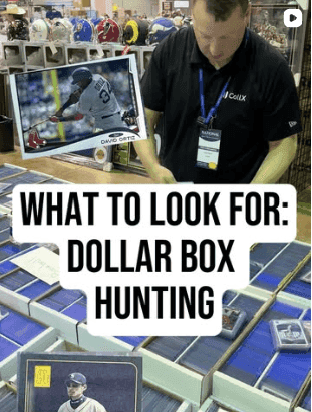
Dollar Box to Deal in a Day
Cass Sapir
How to find the best bargains in dollar boxes at a card show and list them quickly using an auto-feed scanner and Card Dealer Pro.

Dollar boxes can be one of the most enjoyable and affordable ways to source trading card inventory. They can also be overwhelming.
At a large card show, a dealer may have hundreds of thousands of cards spread across dozens of boxes. The key is not to examine every card. Instead, quickly identify the sections that match your selling strategy, pull recognizable players and interesting cards, and use Card Dealer Pro to process the inventory efficiently.
In these two videos, we walk through the complete workflow—from searching a dollar box to scanning, identifying, pricing, and listing the cards on eBay and CollX.
Video 1: How to Search a Dollar Box
https://www.instagram.com/collxapp/reel/DboImAqE1va/
When you approach a large dollar-box display, begin by quickly flipping through several sections to understand what kinds of cards are available.
One box may contain mostly ultra-modern baseball cards, while another section may contain junk-wax-era cards, retired stars, reprints, rookies, inserts, or unusual releases.
Instead of slowly reviewing every card, look for a promising section and then focus your search there.
Look for Players You Know Will Sell
A simple sourcing strategy is to pull recognizable players with consistent collector demand.
Examples from the videos include:
Gary Carter
Roger Clemens
Mike Schmidt
Ichiro Suzuki
Bill Mazeroski
David Ortiz
Wally Joyner
Mickey Mantle
Nolan Ryan
Michael Jordan
Kobe Bryant
George Brett
Thurman Munson
These cards may not individually be extremely valuable, but recognizable players can attract buyers and help create steady sales.
Look for Oddball and Unfamiliar Sets
Cards from unusual, regional, promotional, or less-common sets can also be worth pulling.
For example, the video highlights cards from Conlon and Topps Collector Series releases. These kinds of cards may stand out from the more common cards surrounding them and can appeal to player collectors or set collectors.
A useful rule is:
When you see a recognizable player in a set you do not regularly encounter, take a closer look.
Pay Attention to Reprints and Retired Stars
Reprints of iconic players can also sell, particularly when they feature players such as Mickey Mantle, Ichiro, or Hall of Fame stars.
The card does not have to be an original vintage issue to attract a buyer. Many collectors are interested in affordable cards featuring their favorite players.
Use Quantity Discounts
Many dollar-box dealers offer bulk pricing, such as:
$1 per card
20 cards for $10
Larger discounts for buying a full stack
In the video, 48 cards were purchased for approximately $0.40 per card.
Quantity discounts reduce the cost basis of each card and provide more room for marketplace fees, shipping expenses, and profit.
Before selecting cards, check the dealer’s sign or ask whether quantity pricing is available.
Video 2: Scan, Identify, Price, and List the Cards
https://www.instagram.com/carddealer_pro/reel/DbqURJSAiHf/
After purchasing the cards, the next step is turning them into active listings.
This is where an efficient scanning and listing workflow becomes important.
Step 1: Scan the Cards
The cards were loaded into a Ricoh fi-8170 autofeed scanner in small groups of approximately 10 cards.
An autofeed scanner captures front and back images of each card and can process large quantities of inventory quickly.
Benefits include:
Fast front-and-back imaging
Consistent card images
Less manual photography
A repeatable workflow for larger quantities of inventory
The scanner used in the video had already processed approximately 60,000 cards, demonstrating how this type of hardware can support a high-volume card business.
Always follow the scanner manufacturer’s operating guidance and test your workflow with lower-value cards before scanning valuable or condition-sensitive inventory.
Step 2: Upload the Images to Card Dealer Pro
After scanning, the card images are uploaded through Magic Scan in Card Dealer Pro.
Card Dealer Pro uses AI-assisted recognition to compare the uploaded card images against its card database and identify the cards.
This reduces the need to manually type information such as:
Player name
Year
Manufacturer
Set
Card number
Parallel or variation
Additional listing details
The recognition results should still be reviewed before publishing, particularly for cards with similar designs, variations, parallels, or reprints.
Step 3: Review and Price the Cards
Once the cards have been identified, review the card details and assign prices.
When pricing inexpensive cards, consider:
Recent comparable sales
Current marketplace listings
Player popularity
Card condition
Set scarcity
Your cost per card
Marketplace fees
Shipping and handling costs
Not every card needs to generate a large profit individually. A repeatable workflow can make lower-priced inventory worthwhile by reducing the amount of labor required to create each listing.
Step 4: List the Cards to Multiple Marketplaces
After reviewing and pricing the cards, they can be listed to connected marketplaces such as:
eBay
CollX
Card Dealer Pro allows dealers to manage the card information and publish listings without recreating each listing separately for every marketplace.
This helps reduce duplicate work and makes it easier to expose inventory to buyers across multiple sales channels.
The Complete Workflow
In less than an hour, the workflow shown in the videos included:
Searching the dollar boxes
Identifying recognizable players and interesting sets
Purchasing approximately 40–50 cards
Scanning the front and back of each card
Uploading the images to Card Dealer Pro
Using AI-assisted card recognition
Reviewing and pricing the cards
Listing the inventory to eBay and CollX
The objective is not simply to find the single most valuable card in the box.
The objective is to build a sourcing and listing process that is enjoyable, repeatable, and efficient.
Tips for Your Next Dollar-Box Search
When searching dollar boxes:
Scan several sections before committing to one box.
Look for recognizable stars, Hall of Famers, rookies, and popular players.
Pay attention to oddball sets and cards you have not seen before.
Consider affordable reprints of iconic players.
Check for quantity discounts.
Know approximately what you can sell the cards for before buying.
Avoid spending too much time researching one inexpensive card.
Build around players and categories that already perform well for your business.
Review every AI identification before listing.
Account for marketplace fees, shipping costs, and your time.
Turn Affordable Finds Into Active Inventory
Dollar boxes provide an accessible way to source inventory, discover unusual cards, and enjoy the search.
The larger opportunity comes from combining smart sourcing with an efficient operating system.
With an autofeed scanner and Card Dealer Pro, a stack of inexpensive cards can move from a dealer’s box to active marketplace listings in the same day—without manually photographing, identifying, and typing every card one at a time.