The Raw Card Pricing Playbook - Part 2 - Market Value Tiers
Cass Sapir
A $0.50 card, a $5 card, and a $50 card may all be raw singles — but they re priced differently. In Part 2 of the Raw Card Pricing Playbook, we look at how market value tier changes the pricing rule. We show why low-end cards need floors, mid-tier cards need balance, and stronger raw cards need more careful review.
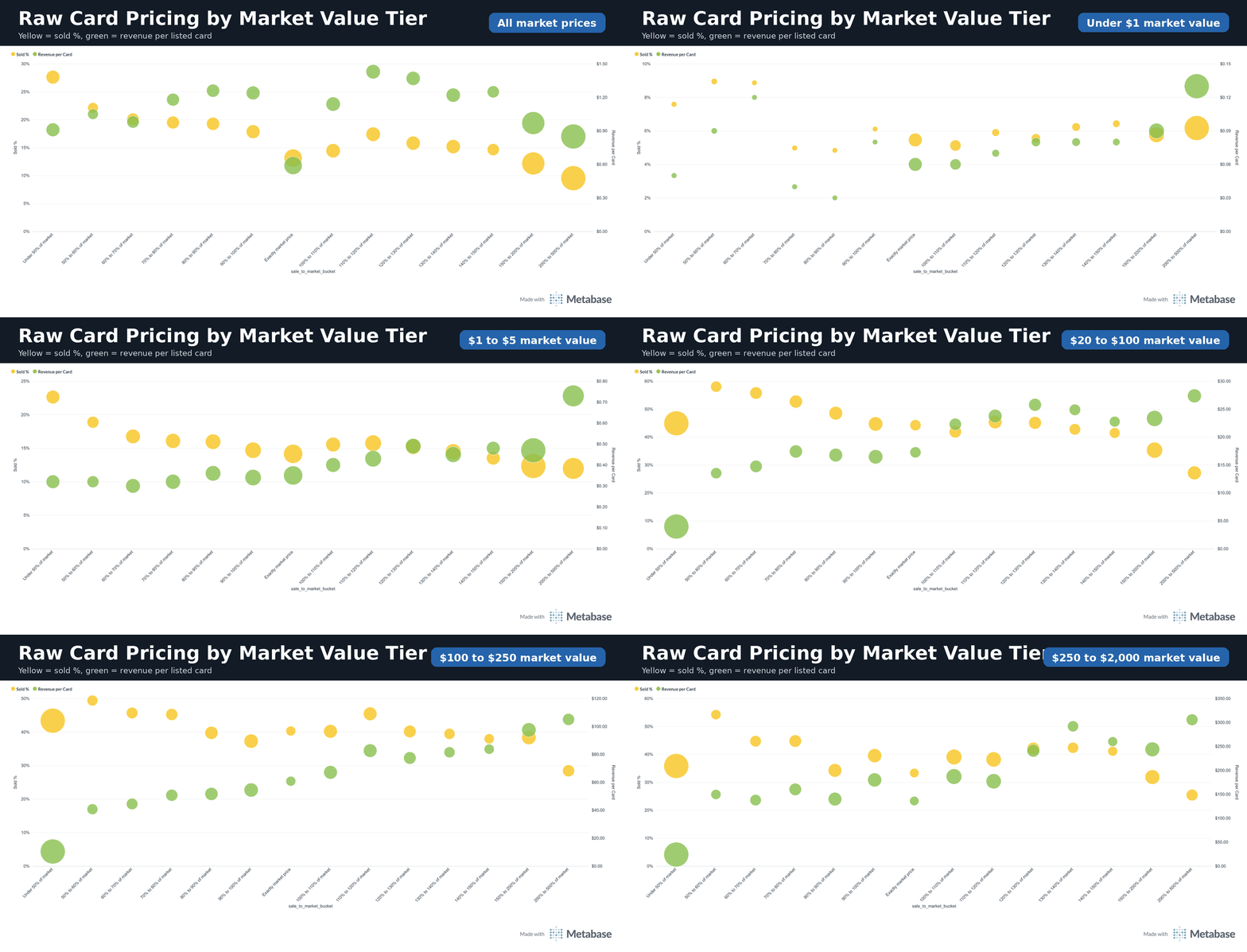
Market Value Tier: Why a $0.50 Card, a $5 Card, and a $50 Card Need Different Pricing Rules
In Part 1 of the Raw Card Pricing Playbook, we looked at the first pricing question every dealer faces:
Should I price this card below market, at market, or above market?
Now we move to the second dimension:
How does this advice change based on market value?
That matters because raw cards do not all behave the same way.
A $0.50 card is usually a bulk economics problem.
A $5 card is usually a real single-card listing decision.
A $50 card is usually a buyer-confidence and pricing-discipline decision.
Those cards may all be raw and ungraded, but they should not be priced with the same rule.
The market value tier changes everything: the buyer, the shipping economics, the dealer’s margin, the level of trust required, and how much time the card deserves before listing.
The Three Cards We Will Follow
To make this practical, we are going to follow three Bobby Witt Jr. cards across three common dealer pricing tiers.
Same player.
Same general raw-card universe.
Very different pricing problems.
The $0.50 Card
2024 Topps Heritage Bobby Witt Jr. #404 — base, raw
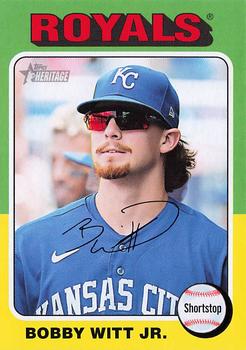
This is the low-end base-card example.
It is a card of a known player, but it is still a common modern raw single. At this level, the question is not just “what is the comp?” The real question is whether the card is worth listing individually at all.
A dealer looking at this card is asking:
Is this worth listing by itself?
Should it go into a lot?
Does it need a minimum price floor?
Is the handling cost higher than the card’s value?
This is the bulk economics problem.
The $5 Card
2022 Topps Series 2 Bobby Witt Jr. #660 Rookie Card — base, raw

This is the standard flagship rookie example.
It is more desirable than a random base card. It is recognizable, it is a rookie card, and it is the kind of raw single many dealers would list individually.
A dealer looking at this card is asking:
What is the right single-card price?
Should I stay close to market?
Should I round to a cleaner price?
Is there enough demand to price a little higher?
Is this a card I want to move quickly or maximize revenue on?
This is the real listing decision.
The $50 Card
2022 Topps Update Bobby Witt Jr. Rookie Debut #US187 Gold /2022 — raw

This is the scarce parallel example.
It is still raw, but it is no longer a bulk-card decision. The card has scarcity, buyer intent, and enough value that the dealer should slow down before pricing it.
A dealer looking at this card is asking:
What do exact recent comps show?
How clean is the card?
Are the photos strong enough?
Is the market price stale?
Does the scarcity justify a premium?
Would a buyer trust this listing at the asking price?
This is the buyer-confidence and pricing-discipline decision.
These three cards make the main point of this article clear:
A $0.50 Bobby Witt base card, a $5 Bobby Witt flagship rookie, and a $50 Bobby Witt parallel should not be priced with the same rule.
The market value tier tells the dealer what kind of decision they are making.
The Big Finding: Most Raw Cards Are Low-End Cards
Our analysis looked at millions of raw, ungraded cards listed through Card Dealer Pro.
The final dataset included:
7,214,780 listed raw cards
1,086,065 sold cards
15.05% overall sell-through
When we split those cards by raw market value, the result was striking.
More than 90% of the analyzed raw cards had a market price under $5.
Here is the breakdown:
Raw Market Price | Listed Cards | Sold Cards | Sold % |
|---|---|---|---|
Under $1 | 1,533,541 | 90,973 | 5.93% |
$1 to $5 | 5,094,823 | 750,468 | 14.73% |
$5 to $20 | 465,098 | 191,641 | 41.20% |
$20 to $100 | 105,429 | 46,565 | 44.17% |
$100 to $250 | 12,180 | 5,015 | 41.17% |
$250 to $2,000 | 3,643 | 1,379 | 37.85% |
$2,000+ | 66 | 24 | 36.36% |
That tells us something important:
The average dealer’s pricing problem is mostly a low-end raw-card problem.
Most cards are not $100 cards.
Most cards are not $500 cards.
Most cards are under $5.
And under $5, the decision is not just “what is the comp?”
The decision is:
Is this card worth listing at all, and if so, what price makes the work worthwhile?
Why Market Value Tier Matters
Card value changes the pricing decision because each tier has different economics.
Low-end cards are shaped by:
Labor
Picking and packing time
Shipping workflow
Fees
Minimum viable listing price
Whether the card should be sold individually or bundled
Mid-range cards are shaped by:
Buyer intent
Shipping cost
Sell-through
Condition sensitivity
Whether the card deserves a premium
Higher-value raw cards are shaped by:
Exact comps
Trust
Photos
Condition
Scarcity
Grading upside
Whether manual review is required
This is why a single pricing rule cannot work for every raw card.
The right rule depends on the tier.
Tier 1: Under $1 Market Price
Examples of cards often in this bucket:
Base commons
Low-demand veterans
Low-end base cards
Bulk Pokémon or TCG commons and uncommons
Low-demand non-rookie cards
Oversupplied modern cards
This bucket had:
1,533,541 listed cards
90,973 sold cards
5.93% sell-through
$0.10 quantity-adjusted revenue per listed card
$0.81 average raw market price
$1.48 average sale price
This is the clearest case where dealers should not follow market price literally.
If a card has a raw market price of $0.40, listing it for $0.40 usually does not make sense. The dealer still has to store it, pick it, pack it, ship it, handle any support issues, and pay fees.
At this tier, the market price may be real, but it may not be economically useful as the actual listing price.
What this means for dealers
For cards under $1, the pricing question is not:
How do I match market?
The question is:
Is this card worth selling individually?
If yes, use a minimum price.
If no, bundle it, lot it, or treat it as clearance inventory.
Recommended approach
For raw cards under $1 market value:
Do not price literally off market
Use a minimum single-card price
Consider $1.49 to $1.99 as a practical floor
Bundle or lot low-end cards when possible
Use deep discounts only for clearance
Do not let a $0.40 or $0.60 market price force an unprofitable listing
Best rule:
Under $1 cards need a floor, not a formula.
Tier 2: $1 to $5 Market Price
Examples of cards often in this bucket:
Base stars
Lower-end rookies
Common inserts
Low-end parallels
Popular players from mass-produced sets
Low-end TCG rares or holos
This is the biggest raw-card bucket by far.
It had:
5,094,823 listed cards
750,468 sold cards
14.73% sell-through
$0.44 quantity-adjusted revenue per listed card
$1.76 average raw market price
$2.23 average sale price
This is where our Bobby Witt Jr. Rookie Debut example fits.
If CDP shows a raw market price of $1.87, the card is not trash. But it is still low enough that pricing it at exactly $1.87 may not be the smartest move.
At this tier, dealers need a practical pricing floor.
A $1.87 market card might be better listed at:
$1.49 or $1.50 if the goal is a fast sale
$1.99 or $2.00 if the card is recognizable and worth listing individually
$2.99 or $3.00 if demand is strong or the dealer wants to preserve margin
Part of a lot if the card is not worth the individual handling
What the data showed
For $1 to $5 cards, the highest revenue-per-listed-card result came from cards priced well above their raw market value in percentage terms.
That sounds strange until you remember the actual dollars.
A card with a $1.50 market price listed at $3.99 may be more than 200% of market, but it is still only a $3.99 card.
At this tier, a dealer is not really “overpricing” in the same way they would be if they listed a $100 card for $250.
They are protecting the economics of a low-end single.
Recommended approach
For raw cards with $1 to $5 market value:
Use market price as a reference
Maintain a practical pricing floor
Consider $2.99 to $4.99 for many individually listed cards
Price lower when moving volume matters
Use offers or markdowns to clear stale inventory
Do not blindly undercut market on low-end singles
Best rule:
For $1 to $5 cards, the listing has to be worth the work.
Tier 3: $5 to $20 Market Price
Examples of cards often in this bucket:
Better rookies
Popular inserts
Star parallels
Lower-end numbered cards
Desirable modern stars
Mid-tier Pokémon or TCG singles
Cards strong enough to sell individually, but still low enough for low-cost shipping workflows
This is one of the most important raw-card pricing zones.
It had:
465,098 listed cards
191,641 sold cards
41.20% sell-through
$4.32 quantity-adjusted revenue per listed card
$9.20 average raw market price
$9.49 average sale price
This tier behaves very differently from the under-$5 tiers.
Once a card has a raw market value between $5 and $20, it is usually worth listing individually. Buyers are more intentional. The card has more room for margin. The dealer has more pricing flexibility.
This is where market price starts to become a stronger anchor.
What the data showed
In this tier, cards had strong sell-through across many price bands.
The best revenue results often came from cards priced above market, but not wildly above market.
That means dealers do not need to race to the bottom.
For a $9 card, a dealer may be better off listing at $9.99, $10.99, $11.99, or $12.99 than trying to undercut every comparable sale.
Recommended approach
For raw cards with $5 to $20 market value:
Treat this as the disciplined raw-card sweet spot
Default around 110% to 140% of market
Use 80% to 100% of market when faster movement matters
Use 130% to 150% for strong demand, clean condition, or good eye appeal
Be careful crossing the $20 threshold unless the card clearly deserves it
Best rule:
For $5 to $20 cards, price slightly above market when revenue matters and slightly below market when speed matters.
Tier 4: $20 to $100 Market Price
Examples of cards often in this bucket:
Strong rookies
Numbered parallels
Popular short prints
Lower-end autographs or relics
Better TCG chase cards
Desirable raw cards with real buyer intent
This bucket had the strongest overall sell-through of any major tier.
It had:
105,429 listed cards
46,565 sold cards
44.17% sell-through
$16.56 quantity-adjusted revenue per listed card
$38.82 average raw market price
$37.21 average sale price
At this level, the dealer should slow down.
A $40 raw card is not a bulk single. It is worth checking whether the card is clean, whether photos are strong, whether there are recent comps, and whether the player or set has momentum.
Market price becomes more useful here, but the card itself matters more too.
Recommended approach
For raw cards with $20 to $100 market value:
Use market price as a strong anchor
Default around 110% to 130% of market
Use 90% to 110% when faster movement matters
Use 130% to 150% for clean, hot, scarce, or well-photographed cards
Avoid pricing above 150% unless there is a clear reason
Best rule:
For $20 to $100 cards, price with discipline. Modest premiums work better than extreme markups.
Tier 5: $100 to $250 Market Price
Examples of cards often in this bucket:
Premium raw rookies
Better numbered cards
Desirable autographs
Key inserts
Strong TCG chase cards
Cards with condition sensitivity or grading upside
This is premium raw territory.
It had:
12,180 listed cards
5,015 sold cards
41.17% sell-through
$53.87 quantity-adjusted revenue per listed card
$145.87 average raw market price
$133.56 average sale price
At this tier, pricing becomes less automatic.
The dealer should check exact comps, condition, photos, surface, centering, player momentum, and whether the card has grading upside.
A premium raw card may justify a higher price, but only if the card supports it.
Recommended approach
For raw cards with $100 to $250 market value:
Use market price as the anchor
Start around 110% to 150% of market for strong cards
Price closer to 90% to 110% for flawed, cold, or common cards
Check exact comps before listing
Use high-quality images
Be honest about condition
Think about whether the card has grading upside
Best rule:
For $100 to $250 raw cards, do not autoprice blindly. Market price is the starting point, not the decision.
Tier 6: $250 to $2,000 Market Price
Examples of cards often in this bucket:
High-end raw rookies
Rare parallels
Key vintage raw cards
Big autographs
High-end TCG chase cards
Cards where condition and authenticity matter heavily
This is manual review territory.
It had:
3,643 listed cards
1,379 sold cards
37.85% sell-through
$153.88 quantity-adjusted revenue per listed card
$451.52 average raw market price
$408.43 average sale price
The number of cards is much smaller, and individual card characteristics matter much more.
These are not commodity cards.
They are individual assets.
Recommended approach
For raw cards with $250 to $2,000 market value:
Do not use a formula alone
Review exact recent comps
Inspect condition carefully
Consider grading potential
Consider scarcity and player momentum
Price above market only when the card clearly supports it
Best rule:
For $250+ raw cards, market price is a guide. Dealer review is mandatory.
Tier 7: $2,000+ Market Price
Examples of cards often in this bucket:
Iconic raw rookies
Rare vintage cards
Low-numbered modern grails
Major autographs
High-end TCG grails
Cards where one comp may not tell the full story
This bucket had only:
66 listed cards
24 sold cards
That is too small to use for broad automated pricing advice.
At this level, every card needs its own review.
Recommended approach
For raw cards over $2,000:
Review manually
Check exact comps
Consider grading
Consider auction vs. fixed price
Consider consignment
Consider direct negotiation
Do not autoprice
Best rule:
At $2,000+, every card is its own market.
The Dealer Cheat Sheet
Here is the simple version.
Raw Market Value | Pricing Approach |
|---|---|
Under $1 | Use a minimum price, bundle, lot, or treat as clearance |
$1 to $5 | Use a practical pricing floor |
$5 to $20 | Use market price to balance sell-through and revenue |
$20 to $100 | Price with discipline |
$100 to $250 | Review condition and exact comps |
$250 to $2,000 | Manual review |
$2,000+ | Manual only |
How This Applies to the Three Bobby Witt Jr. Examples
The market value tier changes the pricing conversation.
2024 Topps Heritage Bobby Witt Jr. #404 — base, raw
If this card has a market value around $0.50, the dealer should not think:
Market is $0.50, so list at $0.50.
Instead, the dealer should think:
This is a low-end base card
The card may not be worth listing individually
If listed individually, it probably needs a minimum price floor
It may make more sense in a player lot, team lot, set lot, or bargain box
The dealer should protect against unprofitable handling
A reasonable pricing conversation might start around:
Bundle or lot if the goal is efficiency
$1.49 or $1.99 if listing individually
Clearance only if the dealer is intentionally moving bulk
For this card, the pricing decision is mostly about listing economics.
2022 Topps Series 2 Bobby Witt Jr. #660 Rookie Card — base, raw
If this card has a market value around $5, the dealer should not treat it like bulk.
Instead, the dealer should think:
This is a recognizable flagship rookie
It is likely worth listing individually
Market price is a useful anchor
The price should still be clean and buyer-friendly
The dealer can decide between speed and revenue
A reasonable pricing conversation might start around:
$4.99 if staying close to market
$5.99 or $6.99 if the card is clean or demand is strong
Slightly lower if the goal is fast movement
For this card, the pricing decision is a real single-card listing decision.
2022 Topps Update Bobby Witt Jr. Rookie Debut #US187 Gold /2022 — raw
If this card has a market value around $50, the dealer should slow down.
Instead of relying on a simple floor or automatic ladder, the dealer should think:
This is a scarcer parallel
Exact comps matter more
Condition and photos matter more
Buyer confidence matters more
A premium may be justified, but only with a reason
Overpricing can reduce trust and slow the sale
A reasonable pricing conversation might start around:
Near market if the goal is a clean sale
Modestly above market if the card is clean, scarce, or demand is strong
Below market only if the dealer wants to move it quickly
Manual review before any aggressive premium
For this card, the pricing decision is about discipline, trust, and exact comps.
The point is simple:
The same player can produce three completely different pricing decisions depending on the card’s market value tier.
That is why dealers should not use one pricing rule for every raw card.
What Comes Next
This article covered the second dimension of smarter pricing:
Market Value Tier.
Next, we will look at the third dimension:
Price Type / Price Ending.
Should a dealer list this Bobby Witt Jr. card at $1.87, $1.99, $2.00, or something else?
That question matters more than most dealers think.
Because the way a price looks can affect how buyers respond.
Final Takeaway
A market price is useful, but it is not enough.
The card’s value tier changes the pricing rule.
For low-end cards, protect your economics.
For $5 to $20 cards, use market price to balance speed and revenue.
For $20 to $100 cards, price with discipline.
For $100+ cards, review condition, scarcity, and exact comps.
For high-end cards, slow down and review manually.
The best dealers do not price every raw card the same way.
They know what tier the card belongs to.
That is where smarter pricing starts.